Why User-Generated Content Galleries Boost Shopify Conversions: The Psychology Behind Social Proof in E-Commerce

Shopify store owners constantly search for ways to increase conversions without inflating their advertising budgets. User-generated content galleries have emerged as a practical solution that transforms how customers interact with online stores.
When real customers share photos, reviews, and videos of products they've purchased, it creates social proof that dramatically increases trust and purchasing confidence among potential buyers. This authentic content addresses one of the biggest barriers in online shopping: the inability to see and experience products before buying.
This guide explores how to effectively implement user-generated content galleries across a Shopify store, from collecting authentic customer content to strategically placing it where it influences purchasing decisions most. Store owners will discover which types of content drive the strongest results, the best tools for managing submissions, and proven methods for measuring the impact on conversion rates.
The Role of User-Generated Content Galleries in Shopify Conversions
User-generated content galleries transform how potential customers interact with Shopify stores by replacing polished marketing materials with authentic proof from real customers. This shift from brand-controlled messaging to customer-validated experiences directly influences purchasing decisions and drives measurable improvements in conversion rates.
Why Authentic Content Outperforms Branded Imagery
Professional product photography often creates an expectation gap between marketing materials and reality. Customers have learned to view branded imagery with skepticism, knowing these images represent idealized versions of products.
UGC galleries bridge this gap by showing products in real-world contexts. When shoppers see photos from actual customers using items in their homes, wearing clothing in different body types, or testing products in everyday situations, they gain practical information that staged photography cannot provide.
Research consistently shows that shoppers trust content from other customers more than brand-created materials. A visitor viewing customer photos can assess fit, scale, color accuracy, and functionality without relying solely on marketing claims. This transparency reduces purchase anxiety and hesitation.
The unpolished nature of UGC actually strengthens its persuasive power. Authentic photos taken with smartphones in natural lighting provide reassurance that products deliver value in real-world conditions, not just under studio lights.
Understanding the Psychology of Social Proof
Social proof operates on a fundamental principle: people look to others' behavior when making decisions. In e-commerce, this psychological mechanism becomes particularly powerful because online shoppers lack physical product interaction.
When a Shopify store displays galleries of customer photos and reviews, it demonstrates that real people have purchased, received, and used these products. This visible evidence of satisfied customers reduces perceived risk in the buying decision.
The effectiveness of social proof increases with quantity and diversity. A gallery containing dozens of customer images signals popularity and reliability more effectively than a few testimonials. Shoppers subconsciously reason that if many others have purchased successfully, their own transaction will likely be positive.
UGC galleries also trigger FOMO (fear of missing out) by showing active community participation. When potential buyers see others sharing their purchases and experiences, they want to join that community of satisfied customers.
Conversion Rate Uplift From UGC Galleries
Shopify stores implementing UGC galleries typically experience conversion rate improvements ranging from 20% to 160%, depending on industry and implementation quality. These gains stem from reduced purchase friction and increased customer trust.
The impact varies by product category. Fashion and beauty retailers often see the highest lifts because customers need visual confirmation of fit, color, and appearance. Home goods and electronics also benefit significantly as customers want to see products in actual living spaces.
UGC galleries particularly influence visitors who are comparison shopping or experiencing purchase hesitation. When a potential customer moves from product pages to galleries multiple times before converting, the authentic content serves as the final validation needed to complete the purchase.
Stores that integrate UGC galleries throughout the customer journey - from homepage to product pages to checkout - capture conversions at multiple touchpoints. Each exposure to authentic content from real customers reinforces trust and moves shoppers closer to purchase.
Types of User - Generated Content That Drive Results

Different forms of user-generated content serve distinct purposes in the conversion process. Customer photos, written reviews, and video content each contribute unique social proof that influences purchase decisions.
Customer Photos and Visual Reviews
Customer photos provide authentic product representation that professionally styled images cannot match. These unfiltered visuals show products in real-world settings, helping potential buyers visualize ownership and use cases.
Photo reviews combine images with written feedback to create comprehensive product assessments. Shoppers trust these visual reviews because they reveal actual product appearance, size, and quality without marketing polish. Studies indicate that products with customer photos convert significantly better than those with only brand photography.
Visual reviews address common purchase hesitations by showing fit, color accuracy, and scale. A dress photographed on various body types provides more value than a single model shot. Kitchen appliances shown in actual homes demonstrate practical integration better than studio backgrounds.
Brands can encourage photo submissions through post-purchase email campaigns, social media hashtags, and incentive programs. The most effective customer-generated content comes from genuine user experiences rather than forced or overly curated submissions.
Customer Reviews and Testimonials
Written customer reviews serve as the foundation of social proof for e-commerce stores. These text-based assessments provide detailed product insights, usage experiences, and satisfaction levels that influence buying decisions.
Key elements of effective reviews:
Specific product details and features
Honest pros and cons
Purchase context and intended use
Authenticity indicators like verified purchase badges
Testimonials differ from standard reviews by focusing on overall brand experience and customer satisfaction. These endorsements work particularly well for establishing trust with new visitors and supporting premium pricing strategies.
Real customer experiences documented through reviews answer pre-purchase questions and reduce support inquiries. Detailed feedback about sizing, durability, or performance helps shoppers make informed decisions. Negative reviews, when handled properly, actually increase credibility by demonstrating transparency.
Video Testimonials and Stories
Video testimonials deliver the most engaging form of social proof through authentic customer stories. These recordings capture emotion, enthusiasm, and detailed product demonstrations that text and photos cannot fully convey.
Customer stories in video format create emotional connections between potential buyers and existing users. A three-minute video showing someone solving a problem with a product resonates more deeply than paragraphs of description. The visual and auditory elements build trust through body language, tone, and genuine reactions.
Video content performs exceptionally well for complex products requiring demonstration or lifestyle items benefiting from contextual presentation. Fitness equipment shown in home workout videos or software explained through user tutorials provide clarity that accelerates purchase confidence.
These videos need not be professionally produced. Smartphone recordings often outperform polished content because authenticity matters more than production quality. Brands can collect video testimonials through dedicated landing pages, social media campaigns, or direct customer outreach following positive experiences.
Strategic Placement of UGC Galleries for Maximum Impact
UGC galleries deliver the strongest conversion impact when positioned at critical decision points throughout the customer journey. Product pages build pre-purchase confidence, homepages establish community credibility, and checkout flows address last-minute hesitations.
Product Pages for Pre-Purchase Confidence
Product pages represent the primary battleground for conversion decisions. Placing UGC galleries directly below product descriptions allows shoppers to see real customer photos and experiences at the exact moment they're evaluating a purchase.
The most effective product page galleries showcase customer images alongside product reviews, creating a comprehensive view of actual product use. This combination addresses common concerns about sizing, color accuracy, and quality that professional photography cannot convey.
Key elements for product page galleries:
Customer photos organized by product variation or use case
Integration with product reviews to connect visuals with ratings
Filter options by customer attributes (body type, skin tone, usage scenario)
Mobile-optimized grid layout for seamless browsing
Shopify stores that structure galleries with these elements reduce decision fatigue by presenting relevant social proof exactly when customers need it most.
Homepage and Community-Building
Homepage UGC galleries serve a different function than product-specific displays. They establish brand authenticity and showcase community engagement before visitors explore specific products.
A curated homepage gallery should highlight diverse customer experiences and product applications. This approach demonstrates the breadth of the customer base and signals that real people trust the brand. Many successful Shopify stores feature rotating galleries that update with fresh content, reinforcing an active customer community.
Homepage galleries work particularly well when linked to loyalty points programs, encouraging visitors to contribute their own content in exchange for rewards.
Checkout Flow to Reduce Cart Abandonment
The checkout flow presents the final opportunity to reinforce purchase decisions. Strategic UGC placement at this stage addresses last-minute doubts that lead to cart abandonment.
Cart and checkout pages benefit from targeted galleries showing customers who purchased similar product combinations. This social proof validates the shopper's selections and creates confidence in completing the transaction. Short video testimonials or photo compilations load quickly without disrupting the checkout process.
Positioning trust-building content between cart review and payment entry captures hesitant buyers. The gallery should remain subtle and non-intrusive, using compact carousel formats or sidebar placements that complement rather than interrupt the checkout experience.
Collecting and Encouraging Quality Customer Content

Successful UGC strategies depend on making content creation easy and rewarding for customers. The most effective approaches combine clear submission pathways with meaningful incentives that motivate customers to share their genuine experiences.
Branded Hashtags and Social Media Campaigns
Branded hashtags serve as the foundation for organizing and tracking user-generated content across social platforms. A well-designed hashtag should be memorable, unique to the brand, and short enough for customers to type without errors.
Stores can launch dedicated UGC campaigns around product launches, seasonal events, or community themes. These campaigns work best when they include clear instructions about what type of content to share and where to post it. For example, a clothing brand might request photos of customers wearing specific items with styling tips.
Social media platforms like Instagram and TikTok naturally encourage content sharing through their visual formats. Brands should monitor their branded hashtags regularly and engage with submissions through likes, comments, or reposts. This interaction signals to other customers that their content will be valued and potentially featured.
The key is selecting hashtags that align with the brand identity while remaining accessible to the target audience.
Contests, Incentives, and Loyalty Programs
Contests generate concentrated bursts of UGC by offering prizes for the best submissions. Photo contests, video testimonials, and creative product use cases all drive participation when the reward matches the effort required.
Incentive structures should balance value with sustainability. Discount codes for content submission encourage ongoing participation without requiring large prize budgets. Loyalty points integrated with UGC programs reward repeat contributors and strengthen customer relationships over time.
High-margin products particularly benefit from incentive-based UGC strategies since the cost of rewards remains proportional to profit margins. Some brands tier their rewards, offering larger incentives for video content versus static images, or for content that drives measurable engagement.
Referral programs can incorporate UGC elements by rewarding customers who share their experiences and convert new buyers.
Post-Purchase Emails and Feedback Requests
Post-purchase emails reach customers at the moment when product experiences are fresh and opinions are forming. These automated messages should request specific types of content rather than generic reviews.
Timing matters significantly for email requests. Beauty and consumable products benefit from 7-14 day delays, while electronics or furniture might need 30 days for customers to fully evaluate their purchases.
The email should include direct links to submission forms, social media platforms, or review pages to minimize friction. Some stores embed image upload functionality directly in emails or link to mobile-optimized submission pages.
Customer feedback collected through these channels provides both UGC for galleries and valuable product insights. Stores can segment their requests based on purchase history, asking loyal customers for detailed testimonials while requesting simpler photo submissions from first-time buyers.
Integrating and Managing UGC Galleries With Shopify Apps
Successfully implementing UGC galleries requires selecting the right tools, establishing moderation workflows, and ensuring seamless technical integration. The right combination of apps and management practices determines whether UGC becomes a conversion asset or an operational burden.
Best Shopify UGC Apps and Platforms
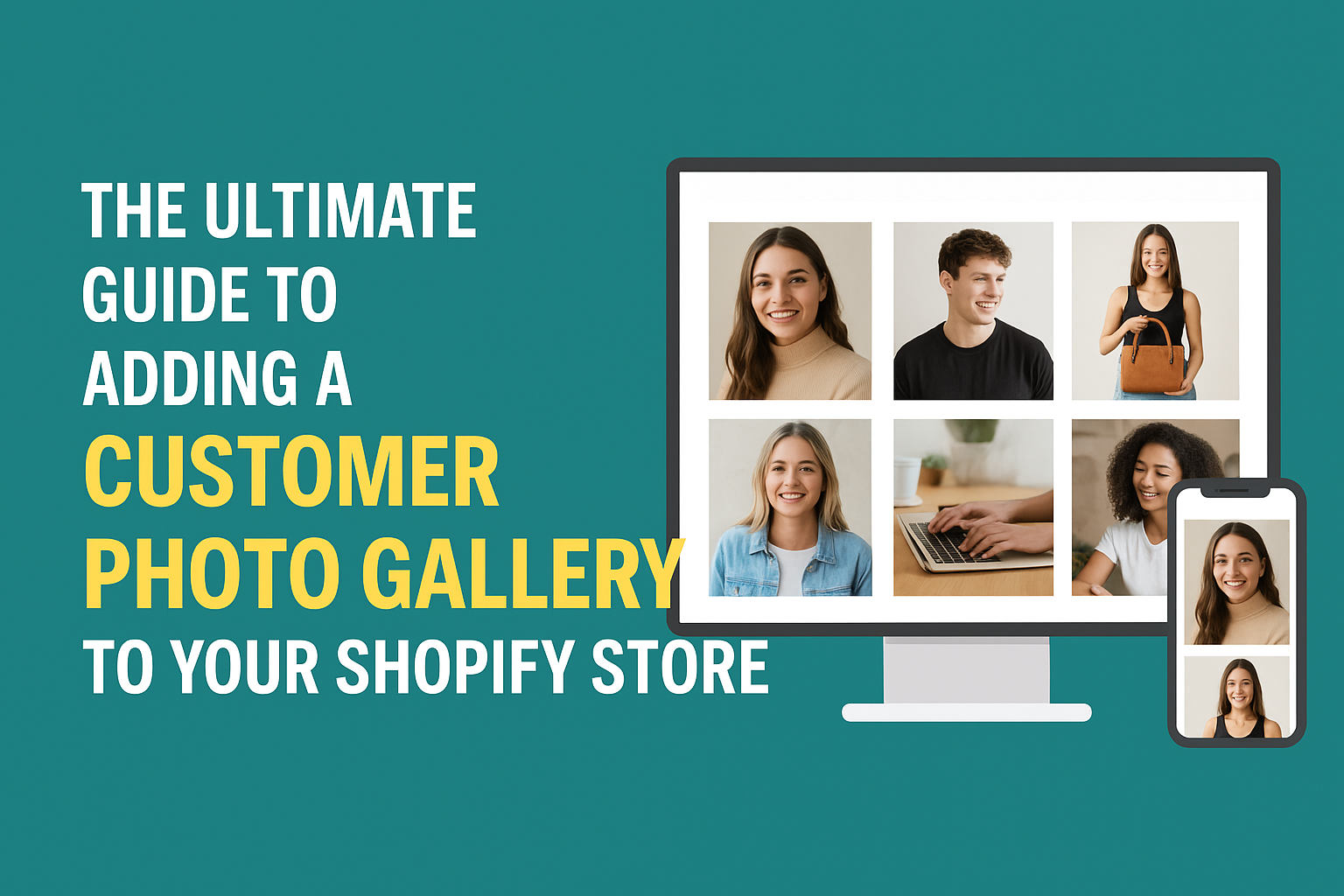
Uploadify – Customer Gallery gives merchants a complete UGC system where customers can upload photos directly on the store. The app includes product tagging, custom attributes, search and filtering, moderation tools, and fully embeddable galleries that fit any Shopify theme. It is designed for brands that want full control over their customer photo galleries without relying only on social media content.
Loox specializes in photo reviews and offers automated review request emails with visual galleries that integrate directly into product pages. The app supports bulk importing and provides customizable widgets that match store branding.
Judge.me provides a cost-effective solution with unlimited reviews and photos on all plans. It includes carousel displays, automated review collection, and integration with Google Shopping for enhanced SEO benefits.
Stamped delivers advanced customization options for galleries, including Instagram integration and community Q&A features. The platform supports video reviews and offers detailed analytics to track UGC performance across different touchpoints.
Yotpo uses AI-powered automation to collect and manage UGC at scale. It connects social media content with on-site galleries and provides sophisticated segmentation tools for displaying relevant content to specific customer groups.
Okendo focuses on attributable reviews that can be tied to actual sales data. It offers advanced display rules and personalization features that show the most relevant UGC based on visitor behavior.
Foursixty and EmbedSocial excel at social media aggregation, pulling content from Instagram, TikTok, and other platforms into shoppable galleries. These apps work well for brands with strong social presence who want to leverage existing customer content.
Moderation and Rights Management
Every UGC implementation needs clear moderation workflows to maintain brand standards and legal compliance. Most Shopify apps include filtering options that flag content containing prohibited words, competitor mentions, or inappropriate imagery before it goes live.
Rights management represents a critical legal consideration. Merchants should obtain explicit permission before displaying customer photos or videos on their Shopify store. Many platforms automate this process by sending permission requests alongside review solicitation emails.
Establishing moderation criteria ensures consistency. Brands should define standards for image quality, content relevance, and message alignment before content appears in galleries. Some apps offer AI-powered auto-moderation that learns from manual decisions over time.
Response protocols matter when customers request content removal. Merchants must implement systems to quickly identify and remove specific pieces of UGC across all display locations when customers revoke permission or delete their original posts.
Optimizing UGC Integration for Seamless Experience
Technical UGC integration affects both site performance and user experience. Gallery widgets should load asynchronously to prevent blocking critical page rendering and slowing load times.
Responsive design ensures galleries display properly across devices. Mobile shoppers account for significant traffic, so galleries must adapt layouts automatically without requiring horizontal scrolling or producing awkward spacing.
Strategic placement determines effectiveness. Homepage galleries build immediate trust, product page galleries provide social proof at the decision point, and dedicated gallery pages enable deeper exploration. A customer gallery pro approach centralizes content while maintaining contextual relevance.
Analytics integration tracks which UGC pieces drive conversions. Merchants should monitor click-through rates from galleries to products, time spent viewing content, and correlation between gallery interaction and purchase completion. This data informs curation decisions and helps identify the most persuasive content types for specific product categories.
Maximizing UGC Gallery Impact With Multichannel Marketing
UGC galleries deliver stronger results when distributed strategically across multiple marketing channels rather than confined to a single storefront location. Brands that repurpose customer content across social platforms, email campaigns, and paid advertising create more touchpoints for conversion while maintaining authentic messaging.
Shoppable Instagram and Social Media Posts
Shoppable Instagram galleries transform customer photos into direct purchase pathways by tagging products within UGC posts. Instagram's native shopping features allow brands to curate customer content into shoppable galleries that link directly to product pages, reducing friction in the buying journey.
Social media platforms like TikTok, Facebook, and Pinterest also support shoppable posts featuring user-generated content. Brands should tag products in customer photos and videos across these platforms to create multiple entry points to their Shopify stores. The authentic nature of UGC in shoppable galleries outperforms traditional product photography because viewers see real customers using products in natural settings.
Consistency across social media platforms strengthens brand recognition while allowing each platform's unique features to showcase UGC differently. Instagram Stories with product stickers, TikTok Shop integrations, and Pinterest Product Pins all serve as effective channels for shoppable UGC galleries.
Email Marketing and Retargeting
Email campaigns that feature UGC galleries generate higher click-through rates than standard promotional emails. Customers respond to seeing real people using products, making UGC an effective tool for cart abandonment sequences, post-purchase follow-ups, and general promotional emails.
Segmented email marketing allows brands to match specific UGC content with relevant customer groups. New subscribers might receive welcome emails featuring beginner-friendly customer content, while loyal customers see advanced use cases. Product-specific emails benefit from including customer photos and reviews related to those exact items.
Retargeting campaigns that incorporate UGC galleries perform better than generic ad creative. Brands can create custom audiences based on product page visits and serve them email content featuring customer testimonials and photos of those specific products. This personalized approach addresses potential objections and builds confidence in purchase decisions.
Leveraging UGC in Google Shopping and Paid Ads
Google Shopping feeds enhanced with UGC imagery show higher engagement rates compared to standard product photos. Brands can submit customer photos as supplementary images in their product listings, giving shoppers a realistic view of items before clicking through.
Paid advertising campaigns across Google, Facebook, and Instagram achieve lower cost-per-acquisition when featuring authentic customer content instead of studio photography. UGC in paid ads generates trust immediately because viewers recognize genuine customer experiences rather than polished marketing materials.
Dynamic product ads that pull from UGC galleries allow for automated retargeting at scale. When shoppers browse specific products, the retargeting system can serve ads featuring real customer photos of those items, creating personalized ad experiences without manual campaign management for each product.
Measuring Results and Refining Your UGC Strategy
Tracking specific metrics reveals how UGC galleries influence customer behavior at each stage of the customer journey, while systematic feedback collection and quality management ensure the strategy evolves with audience expectations.
Key Metrics: Conversion Rate, Engagement, and Loyalty
Conversion rate stands as the primary indicator of UGC gallery performance. Brands should track the difference in conversion rates between product pages with and without UGC galleries to quantify direct impact. A/B testing reveals whether customers who interact with UGC content convert at higher rates than those who don't.
Engagement rate measures how visitors interact with UGC galleries through clicks, views, and time spent on product pages. High engagement combined with low conversion suggests the content attracts attention but fails to address purchase concerns. Low engagement indicates visibility issues or irrelevant content selection.
Customer loyalty metrics including repeat purchase rate and average order value demonstrate long-term UGC strategy effectiveness. Customers who engage with UGC during their first purchase often show higher brand loyalty and return for additional orders. Tracking customer acquisition costs alongside these loyalty metrics helps brands calculate true ROI from UGC investments.
Customer Feedback Loops for Continuous Improvement
Direct customer feedback identifies which UGC types resonate most strongly with shoppers. Post-purchase surveys asking which content influenced buying decisions provide concrete data about customer preferences. This information guides curation priorities and content collection efforts.
Customer engagement patterns across different product categories reveal where UGC galleries deliver the strongest results. Some products benefit more from video demonstrations while others convert better with customer photos showing fit or scale. Analyzing these patterns allows brands to customize gallery formats by product type.
Regular review of customer comments and questions on product pages highlights information gaps that UGC should address. When multiple customers ask similar questions, brands can actively solicit UGC content that answers those concerns.
Adapting to Negative Reviews and Content Quality Concerns
Negative reviews within UGC galleries build credibility when brands respond constructively and use criticism to improve products or descriptions. Customers trust online stores that display balanced feedback more than those showing only positive content. The presence of negative reviews actually increases conversion rates when the overall sentiment remains positive.
Content quality standards must balance authenticity with brand representation. Overly polished UGC appears inauthentic, while poor-quality submissions can undermine product perception. Establishing clear submission guidelines regarding image resolution, lighting, and context helps maintain quality without sacrificing genuine customer voice.
Monitoring content quality concerns requires setting thresholds for different issues. Blurry images, inappropriate content, or misleading representations need removal protocols. However, imperfect photos showing real product use often convert better than professional shots.